Self-tape auditions: the setup that gets you watched
By Screen Entry · 14 September 2026
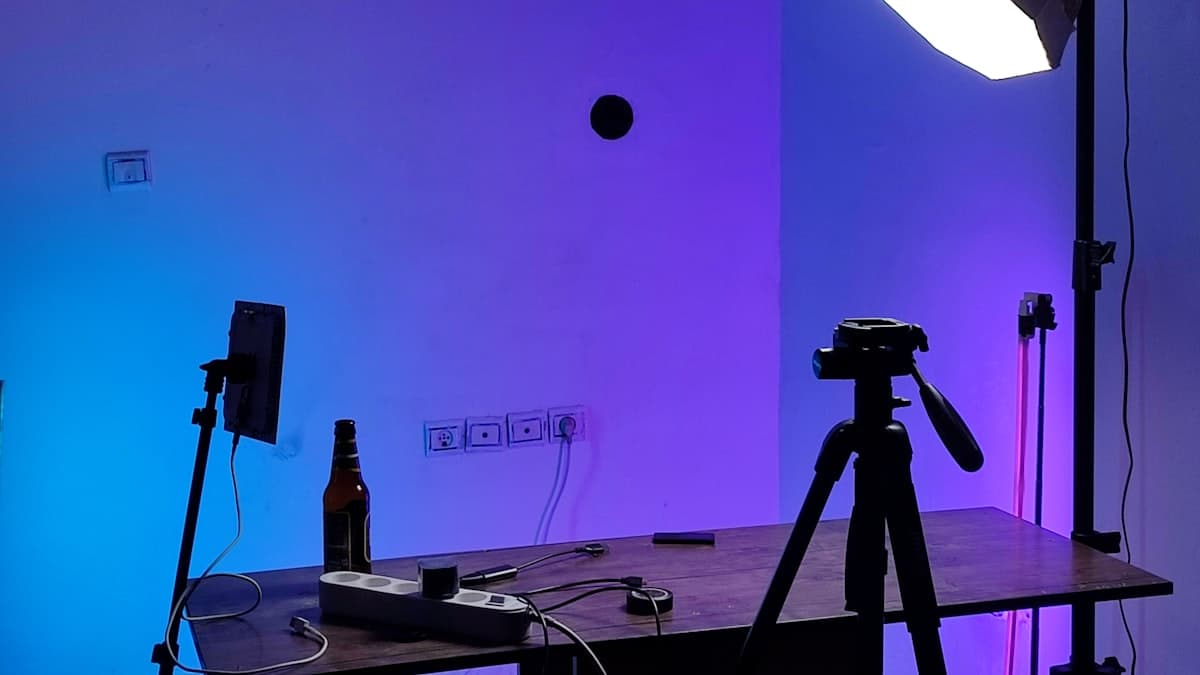
Nobody casts you for your lighting. But bad sound, a busy background or a camera on the floor will get your tape closed before the second line. Here is the setup, in the order it matters.
The self-tape is now the first audition for most roles, and it is judged by someone working through a folder of eighty of them. They are not grading your production values. They are looking for a reason to keep watching.
Everything below is about removing reasons to stop.
Sound first, because it is what actually loses you the tape
Picture quality is forgiving. Sound is not. A viewer will watch a slightly soft image all the way through and will close a tape with echo, traffic or a humming fridge within seconds, because they have to strain to hear you and there are seventy-nine more waiting.
- Record in the smallest soft room you have. Soft furnishings absorb echo; a bedroom with a bed and curtains beats a large empty living room every time.
- Turn off the fridge, the fan, the air conditioning. Do it before you rehearse, not after the third take.
- Get the microphone closer. A phone two metres away in a hard room sounds far worse than the same phone at one metre in a soft one.
- Wired earphones with a mic, just out of frame, beat almost any built-in microphone.
The room
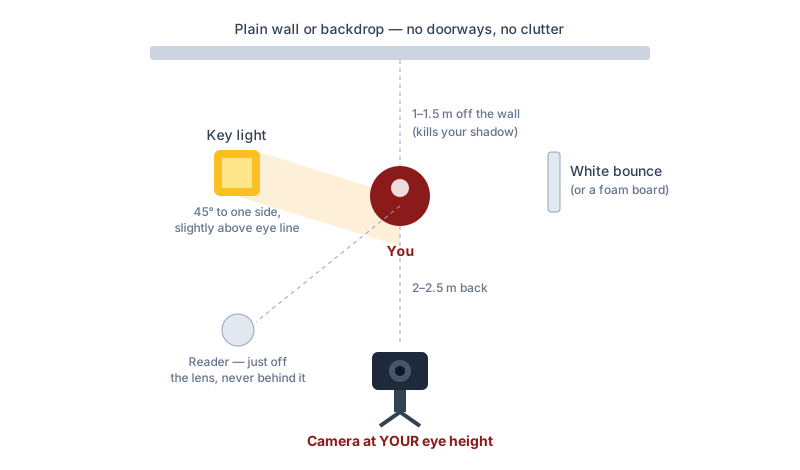
- **Backdrop:** plain and mid-toned. A blank wall is ideal. Blue-grey and mid-grey are safe with any skin tone. Avoid pure white, which forces the camera to darken your face, and avoid anything with a doorway, a shelf or a pattern.
- **Stand off the wall.** A metre or more. This kills the hard shadow behind your head, which is the single most recognisable sign of a rushed tape.
- **Camera at your eye height.** Not on a table pointing up, not on a shelf pointing down. Stack books until the lens is level with your eyes.
- **Two metres back**, then zoom or crop for framing. Standing close to a phone lens distorts your features, and the distortion always flatters you less than the truth.
- **Light from the front.** One soft source at 45 degrees, slightly above your eye line, with something white opposite to bounce fill back. A window works perfectly — face it, never let it sit behind you.
Framing
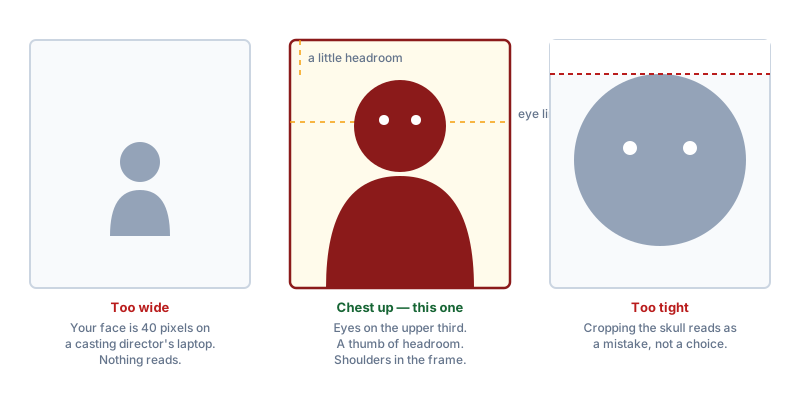
Chest up. Eyes roughly on the upper third of the frame. A small amount of headroom — enough that you are not touching the top edge, not so much that you are floating in the bottom half.
Shoot horizontally unless the brief explicitly says otherwise, and lock the phone's orientation before you start so it cannot flip mid-take.
Your reader
Whoever is reading the other lines sits just beside the camera, at your eye height, and stays quiet and level. They are not auditioning.
Your eyeline goes to the reader, not the lens — close to the lens, but not down it, unless the brief asks for a direct address. And ask them to keep their voice down: their line landing louder than yours ruins the take, and you will not notice until you play it back.
The slate
Unless the brief says otherwise: name, height, location, and the role. Straight to camera, in your own voice, no performance. Then a beat, then the scene.
Slate at the top of the same file. A separate slate video gets separated from your tape and then lost.
Before you send
- **Watch it once, all the way through, with sound.** Almost nobody does this. It catches everything.
- Name the file the way the brief asks. If it does not say, use `Your Name — Role — Project`.
- Send the format requested. If they ask for one file, do not send three.
- Check it plays on a device that is not the one you shot it on.
The tape that gets watched to the end is not the prettiest one. It is the one that never gives the viewer a reason to look away.