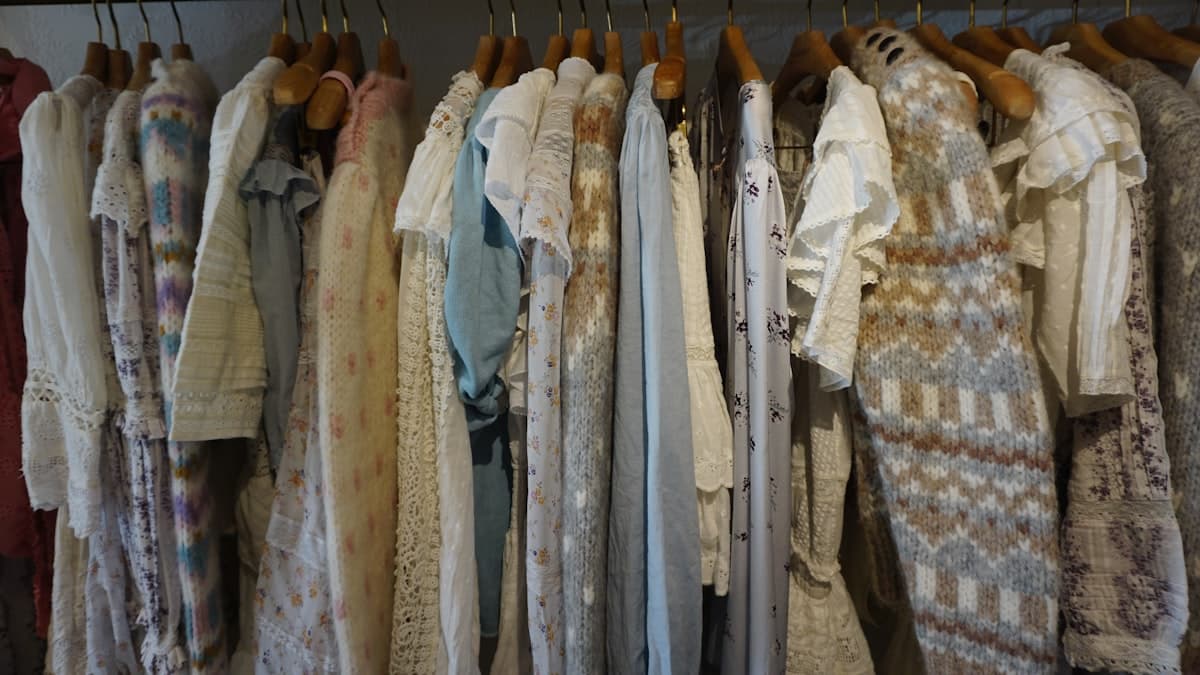
Some clothes behave differently through a lens than they do in a mirror. Three of them can wreck a photograph outright — and it has nothing to do with taste.
Dressing for camera is not dressing well. It is knowing which fabrics and colours misbehave when light passes through a lens and lands on a sensor, and then not wearing those.
Three things cause most of the damage.
Fine patterns break the sensor
A tight stripe, a small check, a herringbone weave: photograph it and it can turn into a shimmering, swirling interference pattern that was never in the room. This is moiré, and it happens when the repeating pattern in the fabric lands at a similar scale to the grid of pixels on the sensor.
It is not a styling opinion. It is a physical collision between cloth and silicon, it cannot be fixed afterwards, and it is worse on video than on stills because it crawls as you move.
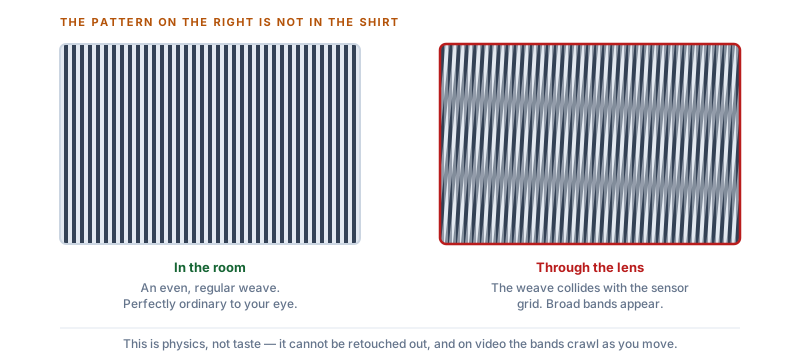
Wear plain, or wear a pattern large enough that the camera can resolve it clearly.
Bright white blows out
A camera exposes for the brightest thing in the frame. Put a brilliant white shirt in a well-lit close-up and the camera pulls the whole image down to protect it — which means your face goes dark, and the shirt still loses all its detail and becomes a flat white shape.
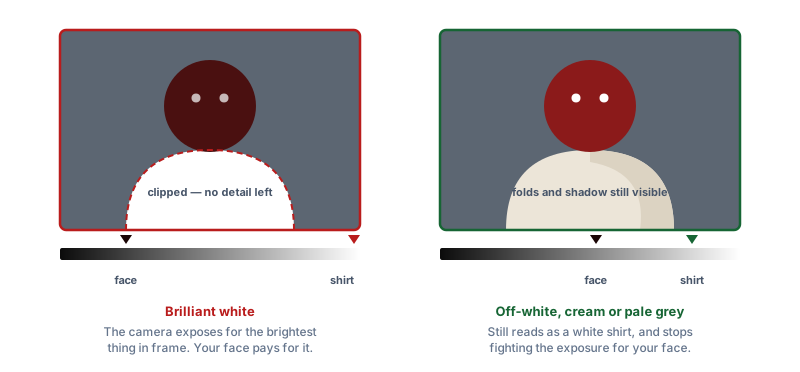
Off-white, cream, light grey and pale blue all read as "white shirt" on camera and none of them fight the exposure. The same logic applies at the other end: a pure black top against a dark background merges into a shapeless mass where your shoulders should be.
Everything that competes with your face
- **Logos and slogans.** The eye reads text before it reads a face. Every time.
- **Busy prints.** They date the photograph and pull attention outward.
- **Shiny fabric.** Satin and sequins throw specular highlights that move as you move.
- **Large or reflective jewellery.** It catches light in stills and clatters on a self-tape microphone.
- **Colours close to your skin tone.** Your face and your top merge into one shape.
- **Colours close to the background.** You disappear into it.
What to actually wear
Plain, well-fitting, mid-toned, in a colour that is neither your skin tone nor your backdrop. Solid jewel tones — a deep teal, a burgundy, a forest green — do well on most complexions. A crew neck or a simple collar keeps a clean line across the bottom of a headshot crop.
And check the fit at the shoulders. A top that fits everywhere else but bunches at the shoulder is the one thing a tight headshot crop will show, because the shoulders are most of what is in frame.
The right wardrobe for camera is the one nobody remembers afterwards. If someone can describe your shirt, it was too loud.