The difference between a photograph you like and a photograph casting can use. Most unusable headshots fail on the same four things — and none of them are about how attractive you look.
A headshot is not a portrait. A portrait is meant to be admired. A headshot is a working document, and it has one job: let somebody who has never met you predict what you will look like on their set, on the day, under their lights.
Most headshots that fail do so on four points.
It has to look like you today
This is the whole thing, and it is the most commonly broken rule. The photograph is a promise. Walking into a room and visibly not matching your own headshot costs you the job before you speak, because the first thing you have demonstrated is that your materials cannot be trusted.
Two years is a reasonable outer limit. Change your hair significantly and the clock resets immediately.
The retouching limit
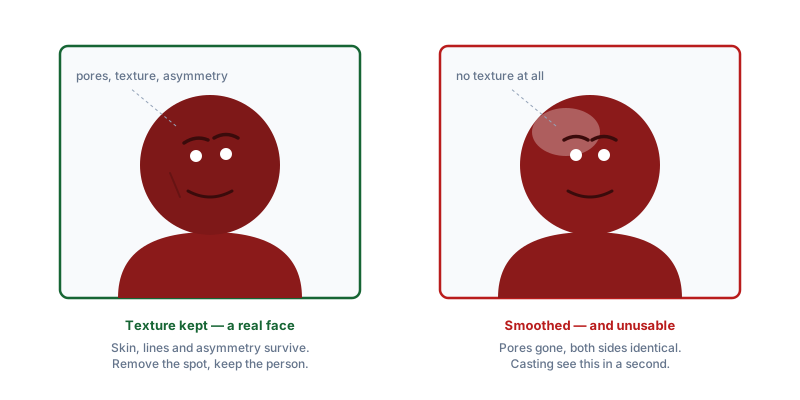
Remove the temporary: a spot, a stray hair, a piece of dust on the lens. Keep the permanent: your skin texture, your lines, the asymmetry every human face has.
Skin smoothing is the tell. Once pores disappear, a face stops reading as a face — and casting, who look at hundreds of these a week, notice instantly. The irony is that the smoothing is usually applied to make someone look better and instead makes them look like they are hiding something.
Eyes, and where the light is
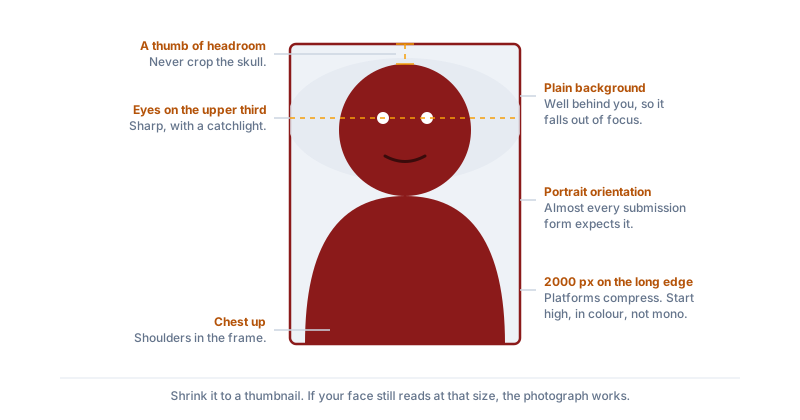
The eyes carry the image. They need to be sharp — genuinely in focus, not almost — and they need a catchlight, the small reflection of the light source that makes an eye look alive rather than flat.
Practical version of the rule: light from slightly above eye level and about 45 degrees to one side. Straight-on light flattens everything. Light from below is the horror-film angle, and your face knows it even if you do not.
The technical floor
- **Framing:** chest up, or head-and-shoulders. Room above the head; never crop the skull.
- **Background:** plain and unfussy, far enough behind you that it falls out of focus.
- **Resolution:** at least 2000 pixels on the long edge. Casting platforms compress; start high.
- **Orientation:** portrait. Almost every submission form expects it.
- **Colour:** colour. Black and white is a style choice that hides hair and eye colour, which are casting information.
- **Wardrobe:** a plain, well-fitting top in a colour that is not your skin tone and not the background.
The test
Shrink it to the size of a thumbnail and look at it.
That is the size at which the first decision about you gets made — a grid of faces on a screen, a few seconds each. If your face still reads at that size, the photograph works. If it becomes a grey smudge with a background, it does not, however good it looks at full size.