Actor's portfolio vs modeling portfolio: what actually differs
By Screen Entry · 14 September 2026
Same person, same photographs, two books that should not look alike. One answers "can I cast you"; the other answers "can I book you". Confusing them costs work in both directions.
Plenty of people work as both an actor and a model, send the same set of images to both, and quietly underperform in both. The images are not the problem. The book is.
The two portfolios answer different questions, and every difference below follows from that.
The question each one answers
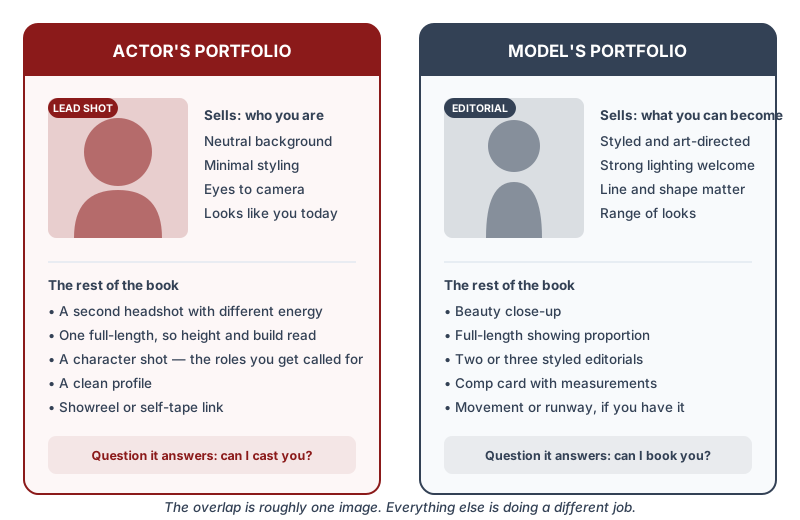
An **actor's** portfolio answers: *can I cast you, and as what?* It is about identity and range. Casting is trying to see a person they can drop into a role — so the book stays close to who you actually are, and any variation is variation of energy, not of appearance.
A **modeling** portfolio answers: *can I book you, and for what?* It is about look, line and versatility of styling. A client is trying to see what you can be turned into — so the book leans on art direction, styling and strong photography, and transformation is a selling point rather than a liability.
That single difference drives everything else.
Where they diverge in practice
**Styling.** An actor's headshot is deliberately under-styled: the photograph is about the face. A model's book expects styling — it is part of what is being sold.
**Lighting.** Actors want clean, honest, front-weighted light that shows the face accurately. Models can use hard light, heavy shadow and colour, because a striking image is itself the point.
**Retouching.** An actor's images must stay true to how they look on the day, and heavy skin work reads as a warning sign. Fashion tolerates far more retouching as a stylistic convention.
**Transformation.** In an actor's book, changing so much you are unrecognisable is a fault. In a model's book, range across looks is the product.
**Measurements.** A model's comp card carries height, bust or chest, waist, hips, shoe and eye colour on the back. An actor generally lists height, and occasionally build, in the résumé instead — precise body measurements are not what casting is choosing on, and volunteering them can read oddly.
**The moving image.** An actor's book is incomplete without a showreel or a self-tape. Most modeling portfolios have no equivalent, though movement or runway footage helps for some markets.
What legitimately carries across
Usually about one image: a clean, honest, well-lit portrait of your face. That frame works as a commercial headshot and as the opener of a beauty section.
The full-length transfers in spirit but rarely in execution — an actor's is plain and functional, a model's is styled and shaped.
If you do both
Keep two books. Not two folders of the same photographs sorted differently — two shoots, or at least two clearly separated sets, each built around its own question.
The cost of merging them is subtle and expensive. A casting director opening a book that leads with a high-fashion editorial reads "model, not an actor," and moves on. A client opening a book of plain grey-background headshots reads "not enough range," and moves on. Neither of them tells you why.
One book, two audiences, is the most common way to be almost right and get nothing.